Self-Evolving AI Systems: Can AI Learn from Its Own Mistakes Without Retraining?
Improving an AI system has traditionally meant a heavy cycle: collect new data, run a training pipeline, evaluate, deploy a new model version. It works, but it is slow, expensive and awkward for anything that has to adapt week to week. Meanwhile, production AI agents keep making the same avoidable mistakes: the wrong column name in a database query, an outdated report template, a troubleshooting step someone already corrected last month.
A growing body of research and engineering practice asks a different question: can an AI system learn from its failures while it is running, without retraining the underlying model? The short answer is yes, with an important qualification about what "learning" means. This article explains what self-evolving AI systems are, the mechanisms behind them (memory, reflection, test-time adaptation and feedback), what recent research reports, the risks that come with letting a system change itself, and a reference architecture you can build on. It extends the controls in our autonomous agents and AI observability guides. Written for engineering leads and architects building agent systems that need to improve in production.
What "Self-Evolving" Actually Means
A self-evolving AI system improves its future performance by learning from interactions, feedback and previous failures. The key distinction is that this does not necessarily mean changing the neural network's weights. A deployed system's behaviour comes from more than its model: it also depends on memory, tools, prompts, workflows and the feedback it receives.
Take an assistant that keeps writing incorrect SQL because it misreads a database schema. Without any retraining, the system can:
- Detect that the query failed
- Read the database error message
- Identify the wrong table or column reference
- Store the correct schema in project memory
- Generate a corrected query
- Reuse the verified schema on future requests
A deployed AI system is more than its weights. Memory, tools and feedback loops are part of its intelligence.
The Improvement Loop
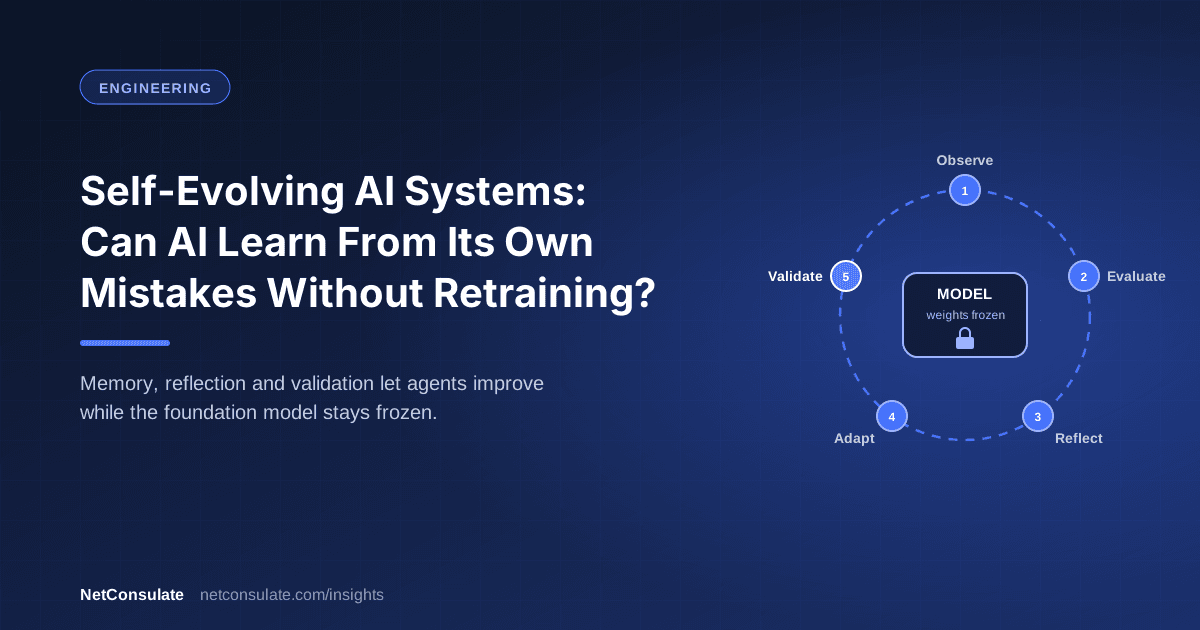
Most self-evolving designs follow the same cycle: Observe, Evaluate, Reflect, Adapt, Execute, Validate.
| Stage | What the system does |
| Observe | Collect task inputs, execution traces and outcomes |
| Evaluate | Compare results against expected outcomes |
| Reflect | Work out where and why the error occurred |
| Adapt | Update memory, prompts, policies or tools |
| Execute | Apply the improved strategy |
| Validate | Measure whether performance actually improved |
Four Mechanisms That Make It Work
Long-term memory. An agent can store task outcomes, failed attempts, verified solutions, user preferences and lessons from feedback, then retrieve them when a similar task appears. A support agent that gave a wrong troubleshooting procedure, and received a verified correction, can retrieve the right one next time. Memory quality matters more than quantity: a stored wrong conclusion makes later decisions worse. Reflection. The agent reviews its own actions and results before accepting an output. A coding agent writes a function, fails a unit test, reads the error, finds an off-by-one boundary, revises the code, reruns the test and records the fix. Frameworks such as Reflexion and Self-Refine have explored this feedback-driven self-correction without conventional parameter updates. Reflection alone does not guarantee learning, though; the lesson has to be kept and shown to help on later tasks. Test-time learning and adaptation. Classic machine learning separates training from inference. Test-time approaches let a system adjust strategies, context, memory or selected parameters while it runs. One example reported in the research is EvoTest, presented at ICLR 2026, which pairs an Actor Agent that performs tasks with an Evolver Agent that studies execution histories and modifies the agent's configuration for the next attempt, reportedly without gradient updates or fine-tuning. Changes can include prompt rewrites, memory updates, hyperparameter adjustments and tool-use routines. Reinforcement learning from feedback. An agent takes actions, receives rewards or penalties and adjusts its policy. A warehouse robot might learn that a navigation strategy produces inefficient routes and find a better one. Unlike the other mechanisms, this can involve updating policy parameters, including during deployment.Not every self-evolving system avoids retraining. The honest question is which layer is changing.
Can AI Improve Without Changing Its Weights?
Yes, but the answer depends on what you count as learning. These approaches should not be confused:
| Approach | Changes model weights? | Persistent improvement? |
| Prompt optimisation | No | Yes, if saved |
| Context-based learning | No | Usually only within a session |
| External memory | No | Yes |
| Workflow optimisation | No | Yes |
| Tool-use adaptation | No | Yes |
| Online fine-tuning | Yes | Yes |
| Reinforcement learning | Often | Yes |
What Recent Research Reports
The following results are as reported by their authors. Treat them as evidence of direction, not as guarantees for your workload, and read the original papers before relying on specific numbers.
Darwin Gödel Machine (2025). Developed by researchers associated with Sakana AI and academic partners, it explores whether coding agents can improve their own implementations. It generates modified versions of an agent, evaluates them and keeps an archive of promising variants. Reported results include SWE-bench performance rising from 20.0% to 50.0% and Polyglot from 14.2% to 30.7%. This is system-level self-improvement through code modification and benchmark evaluation, not a model learning from a conversation. EvoTest (ICLR 2026). Separates task execution from system evolution so that improvements carry across repeated attempts in an environment, without conventional fine-tuning. Self-Direction (October 2026). A paper reported to combine reflection with lightweight, persistent low-rank adapters. Rather than changing the original model, it stores reusable task-specific adaptations in a library for later retrieval. This sits between pure memory-based adaptation and full retraining: it learns additional parameters but keeps the foundation model's weights frozen. We have not independently verified this paper, so check it directly before citing it.Gains in all of these depend on the task, the evaluation method and how reliable the feedback is.
The Risks of Letting a System Change Itself
Autonomous learning introduces failure modes that static models do not have.
| Risk | What goes wrong | Mitigation |
| Learning the wrong lesson | A temporary network error is stored as "the API logic is broken" and applied forever | Validate lessons against execution results and independent evaluators before saving |
| Memory decay and forgetting | New, less reliable entries displace useful knowledge | Versioned memory, consolidation, retrieval prioritisation, regression tests |
| Self-reinforcing errors | The system treats its own wrong answer as evidence it was right | Independent verification, confidence thresholds, human review for high-impact decisions |
| Security and unsafe self-modification | Poisoned memory, prompt injection, unauthorised tool use, unsafe code changes | Sandboxing, permission controls, immutable audit logs, version control, rollback, human approval |
| Unmeasured "improvement" | Different outputs are mistaken for better outputs | Track completion rate, error recurrence, regression rate, generalisation and cost |
A system that changes is not necessarily a system that improves. Measure it.
Evaluation deserves particular care. Useful metrics include task completion rate, error recurrence rate, accuracy, adaptation speed, generalisation to unfamiliar tasks, regression rate and resource use. The goal is reliable gains across many tasks, not a higher score on one benchmark.
A Reference Architecture
A practical self-evolving system combines a foundation model, an agent orchestrator, persistent memory, feedback processing and an independent evaluation engine.
| Component | Responsibility |
| Foundation model | Core reasoning and language |
| Agent orchestrator | Manages tasks, decisions and execution |
| Memory layer | Stores experiences and verified knowledge |
| Feedback engine | Collects outcomes and user feedback |
| Reflection engine | Analyses failures and finds improvements |
| Adaptation engine | Updates prompts, strategies, memory or adapters |
| Evaluation engine | Tests proposed improvements before they are adopted |
| Governance layer | Permissions, safety and auditability |
- The agent produces a business report from enterprise data.
- A validation step flags missing KPIs and wrong calculations.
- Reflection finds the cause: an outdated reporting template.
- The memory layer stores the latest approved requirements.
- The agent changes its workflow to fetch the approved template first.
- The revised workflow is tested against known reporting requirements.
- Future reports use the improved workflow automatically.
The governance layer is not optional decoration. Because the system can change its own behaviour, every change needs an owner, an audit trail and a way back. This is where the identity, scoping and logging practices in our agent identity article apply directly.
Where It Applies
- Software engineering: coding agents that learn from failed tests and refine debugging procedures.
- Customer support: agents that retain verified fixes and stop repeating corrected answers.
- Finance: fraud and anomaly workflows that adapt using verified transaction outcomes, with human review of decisions that matter.
- Healthcare: retrieval and administrative workflows that improve from verified feedback. Clinical decisions still need proper medical validation.
- Manufacturing: maintenance workflows that learn from equipment failures.
- Supply chain: routing and inventory planning that improve from execution history.
What to Actually Do With This Right Now
Start with memory and workflow changes, not weight changes. They are cheap, inspectable and reversible, and they cover most practical gains. Make every learned lesson earn its place. Require evidence before anything is written to persistent memory, and keep memory versioned so a bad lesson can be removed. Keep the evaluator independent of the learner. A system that grades its own work will reinforce its own mistakes. Put humans on the high-impact changes. Let low-risk adaptations flow automatically; require approval for anything touching sensitive workflows, permissions or code. Measure before and after. Baseline error recurrence and task success first, so you can show the system actually improved. Be precise in the claims you make. Improving an agent's configuration is a realistic, deployable goal. Recursively improving the intelligence of the underlying foundation model is a much harder research problem and should not be promised.A Readiness Checklist
- Failure modes and recurring errors identified and logged for your current agents
- Clear decision on which layer may adapt: prompts, memory, tools, adapters or weights
- Persistent memory with versioning, ownership and a way to delete or roll back entries
- Evidence required before any lesson is stored
- Independent evaluation separate from the agent that produced the output
- Regression tests that run after every adaptation
- Sandboxed execution, scoped permissions and immutable audit logs for self-modifying behaviour
- Human approval for high-impact or sensitive changes
- Baseline and ongoing metrics: completion rate, error recurrence, regression rate and cost
Conclusion
AI systems can improve without retraining their foundation models, by combining persistent memory, reflection, feedback-driven adaptation, workflow optimisation and independent validation. Research such as EvoTest and the Darwin Gödel Machine shows different routes to system-level self-improvement, and newer work explores lightweight adapters that capture lessons while keeping the base model frozen. But remembering a mistake is not the same as learning from it. A system has to work out why something failed, separate reliable feedback from wrong assumptions, keep what is useful and prove the improvement. The most valuable AI system may not be the one that never errs, but the one that reliably stops repeating its errors, with the controls to make sure it learns the right things.
If your organisation is building agents that need to improve safely in production, NetConsulate designs agent architectures with memory, evaluation and governance layers built in from the start.
Building AI agents that need to learn and improve safely in production? Submit a proposal request and our team will respond with a tailored approach within 2 business days.