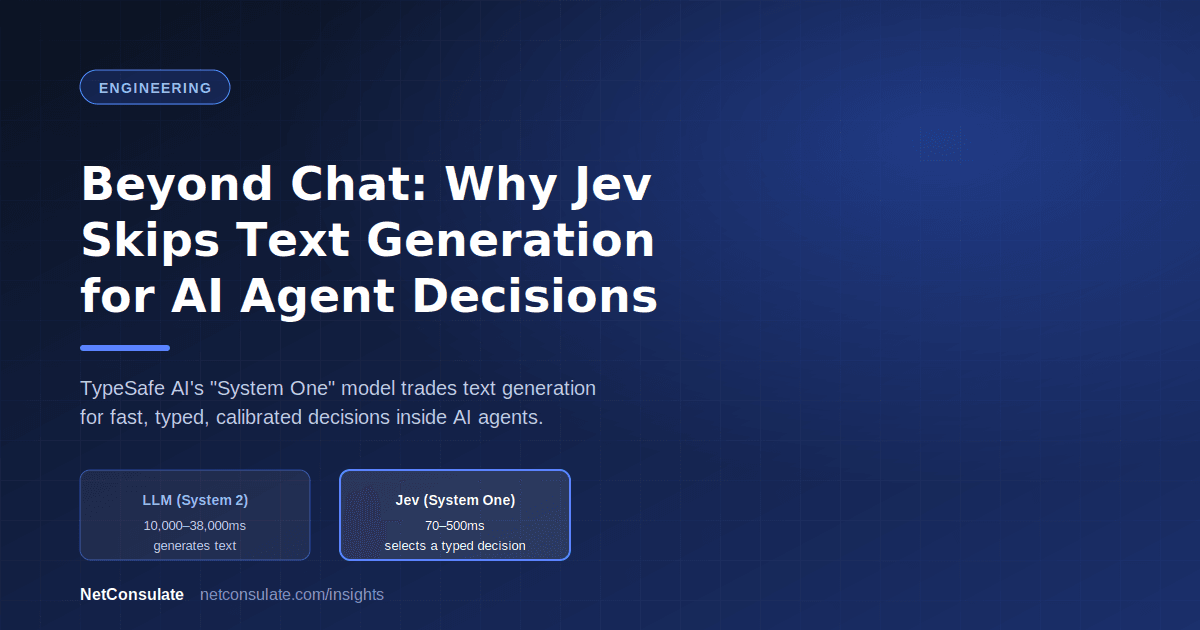
Beyond Chat: Why TypeSafe's Jev Skips Text Generation Entirely for AI Agent Decisions
Most of the conversation about AI agents assumes the model's job is to write: draft the reply, compose the summary, generate the plan. But watch a production agent actually run, and most of its steps are not writing at all. They are decisions. Route this ticket. Classify this document. Is this input safe. Which tool do I call. Should this escalate to a human. Teams have been solving all of these with text-generation models, and then acting surprised when a decision-making step occasionally hallucinates a tool that doesn't exist.
On 15 September 2026, a new company called TypeSafe AI released a model that takes the opposite bet: it does not generate text at all. This article explains what "Jev" actually is, how its training approach differs from the RLHF that built ChatGPT, the real benchmark numbers behind the speed and cost claims, and — more usefully than the announcement itself — where this pattern fits into an agent architecture and where it very much does not. It connects directly to the thesis in our small language models guide: match model architecture to the task, not the other way round. Written for technical decision-makers architecting agent systems today.
What a "System One Model" Actually Is
TypeSafe calls Jev a System One model — a new category name, not a marketing label for an existing architecture. The reference is deliberate: Daniel Kahneman's System 1, the fast, intuitive mode of human thought, as distinct from the slow, deliberate System 2 reasoning that frontier chat models are increasingly optimised for. A System One model takes unstructured program state as input — a JSON object, or a plain string like "my card was charged twice" — and returns typed, probabilistic decisions in a single parallel pass, rather than generating a string one token at a time.
Concretely, given a state and a set of typed questions, Jev returns a choice from a set you define, a rubric score, or a yes/no answer — each with a calibrated confidence value attached. It does not generate; it selects from options you supply, which means, by construction, it cannot return something outside that set or malformed. There is no JSON-parsing step, no schema validation, no risk of the model inventing a tool name that doesn't exist. For a system that has to act on the output programmatically, this is the entire point.
An LLM writes an answer. A System One model picks one — with a number attached saying how sure it is.
RLCD, Not RLHF — A Different Training Bet Entirely
Jev's founder, Diogo Almeida, is a former OpenAI researcher and one of the co-inventors of Reinforcement Learning from Human Feedback (RLHF) — the technique that made ChatGPT's conversational style possible in the first place. TypeSafe's own framing of why he left to build something different is direct: RLHF-trained language models are optimised to please humans and assist in conversation, not to make reliable autonomous decisions inside software that has no human reading the output at all.
Jev is trained instead with what TypeSafe calls Reinforcement Learning for Calibrated Decisions (RLCD) — a training method aimed specifically at producing a model that knows how confident it should be in a given answer, rather than one optimised to sound confident regardless of whether it is. Combined with a non-autoregressive architecture (no token-by-token generation) and a parallel sampler, every question in a single request is evaluated simultaneously — adding more questions to a request barely changes response time, since nothing is generated sequentially.
The Numbers — With the Appropriate Caveats
TypeSafe's own 4-workflow benchmark puts Jev at 67.8% accuracy, close to GPT-5.6 Terra (67.9%) and a few points behind GPT-5.6 Sol (74.1%) and Claude Opus 5 (73.1%). On pure accuracy, Jev is not the strongest model available — that was never the claim. The claim is cost and latency:
| Metric | Jev | Comparable frontier LLMs |
| Cost per case | ~$0.0004 | $0.0304–$0.1761 |
| Latency | 70–500ms | 10,000–38,000ms |
| Pricing | $42 per billion input tokens, output tokens free | Standard per-token pricing on both sides |
Where This Pattern Actually Fits an Agent Architecture
This is the part worth taking seriously regardless of how any single vendor's model performs in practice, because the underlying architectural argument is sound and extends the reasoning in our autonomous agents guide directly.
Good fit — the routing and gating layer. Which tool should this agent call. Is this input safe to process. Should this ticket go to billing or technical support. Does this output meet the bar to auto-approve, or does it need human review. These are exactly the narrow, closed-set, high-volume decisions that a fast typed classifier handles well — and where a full LLM call, at 10 to 38 seconds and cents per request, is genuine overkill for a binary or small-multiple-choice decision made thousands of times a day. Good fit — confidence-gated automation. Every Jev decision returns a confidence score alongside the answer, which maps directly onto the graduated-autonomy pattern our agent architecture guide describes as essential: act automatically when confidence is high, escalate to a human or a stronger model when it is not. At Jev's advertised pricing, checking every single request as it arrives — rather than sampling a subset — becomes economically trivial in a way it simply isn't at frontier LLM pricing. Poor fit — anything requiring generation. Drafting the actual reply, writing the summary, producing the plan a human will read — none of this is what a System One model does, by design. It selects from a defined set; it does not write prose. The moment a task requires open-ended output, this architecture doesn't apply, and no amount of confidence calibration changes that. Poor fit — genuinely novel or ambiguous situations. A closed-set classifier is only as good as the set it was given. Where the right answer might not be among the options anticipated in advance — exactly the kind of situation our agent architecture guide flags as needing ReAct-style exploratory reasoning rather than a fixed plan — a model that can only select from predefined options is the wrong tool, however fast it is.The Hybrid Pattern This Points Toward
The realistic architecture emerging from this isn't "replace your LLM with a decision model." It's routing middleware that assesses each incoming request and chooses the right model for it — a fast, cheap decision model for routing, safety checks, and tool selection, and a full LLM reserved for the steps that genuinely require generation or open-ended reasoning. This is precisely the 80/20 hybrid routing pattern our small language models guide describes as the emerging production default, just with an even sharper cost and latency differential at the extreme end — a System One model isn't a smaller LLM, it's a different kind of primitive entirely, purpose-built for the narrow slice of agent work that was always a poor fit for text generation in the first place.
Early framework integration already reflects this framing — LangChain's provider-agnostic model support treats Jev as a classifier component (invoked to get structured decisions) sitting inside a larger agent harness, not as a chat-completion replacement.
What to Actually Do With This Right Now
Audit your agent's decision points, not just its generation points. Most teams have not separated "steps where the agent writes something" from "steps where the agent picks something" in their own architecture. That separation is the prerequisite for knowing whether a System One-style model would even apply anywhere in your system. Treat the benchmark numbers as a single vendor's claim until independently reproduced. A four-day-old model with one published benchmark suite deserves the same scepticism any new frontier claim does — useful as a signal of where the category is heading, not yet as a number to build a cost projection on. Watch the category, not just the company. Whether or not Jev specifically becomes a lasting product, the architectural bet — that a meaningful share of agent workloads are decisions, not prose, and deserve a purpose-built model rather than a general LLM pressed into service — is a sound one, and likely to attract fast-following competitors regardless of how this specific launch plays out.A Readiness Checklist
- Agent decision points inventoried separately from generation points across your existing or planned agent workflows
- Confidence-gated escalation designed for any high-volume, closed-set decision currently handled by a full LLM call
- Cost and latency baseline established for current routing/classification steps, to make any future comparison meaningful
- Independent verification planned before committing production traffic to any single-vendor benchmark claim, this one included
- Hybrid routing architecture considered explicitly — decision model for narrow gating steps, full LLM reserved for generation and open-ended reasoning
Conclusion
Jev's real contribution, independent of how the product itself fares, is a sharpened version of an argument already gaining ground: not every step inside an AI agent needs a model that writes. A meaningful share of agent work is closed-set decision-making — routing, classification, safety gating, tool selection — and forcing that work through a text-generation model that then has to be parsed and validated is a mismatch that shows up as cost, latency, and occasional hallucinated output. Whether the specific numbers TypeSafe published hold up under independent testing remains to be seen. The architectural question they're asking — what in your agent actually needs to write, versus what just needs to decide — is worth asking regardless of the answer.
If your organisation is architecting agent systems and wants help identifying where decision-optimised models could reduce cost and latency without sacrificing reliability, NetConsulate designs hybrid agent architectures that match model type to task — from routing and confidence-gated automation to the generation steps that still need a full LLM.
Architecting an AI agent system and want the right model at each decision point? Submit a proposal request and our team will respond with a tailored approach within 2 business days.