AI Voice Agents and the Return of the Phone Call: Conversational AI Beyond Chat
While enterprise AI attention has concentrated on chat interfaces, agent frameworks, and copilots, one of the fastest-moving deployment categories in 2026 has been the channel everyone assumed AI would never fully crack: the phone call. Not chatbots that occasionally place a call, and not the rigid press-1-for-billing IVR trees of the last two decades — full, real-time spoken conversations, reasoning and adapting rather than following a script, now handling millions of customer interactions monthly at genuine enterprise scale.
This article explains what changed to make this possible, the real latency and cost numbers behind production deployments, where voice agents are already delivering measurable results, and what building one honestly requires. It connects directly to the interface-design thinking in our Post-Chatbot Era article — voice is arguably the purest expression of that shift, since there is no screen to fall back on when the interface itself has to carry the entire interaction. Written for technical and customer-experience decision-makers evaluating voice AI for the first time.
What Actually Changed — This Isn't the IVR You Remember
The IVR systems of the previous decade operated on rigid menu trees and keyword matching — press 1, say "billing," get routed, repeat your account number to a human who already has it in front of them. Today's voice agents are built on a genuinely different technical foundation: large language models for reasoning, neural text-to-speech with sub-100ms synthesis latency, real-time voice activity detection, and live integration with the same backend systems a human agent would use. The result doesn't follow a script — it reasons, adapts, and resolves within defined boundaries, which is the same underlying shift from generative to agentic AI covered in our autonomous agents guide, applied specifically to spoken conversation.
The scale of adoption is no longer experimental. Over 65% of enterprise contact centers have deployed or are piloting conversational voice AI, and Gartner estimates that by 2027, conversational AI will handle more than half of enterprise contact centre volume — a projection considered wildly ambitious just two years ago. The conversational AI market broadly is projected to reach $41.39 billion by 2030; the voice-agent segment specifically crossed $4.8 billion in 2026, growing at roughly 38% annually.
The Number That Actually Determines Whether a Voice Agent Works: Latency
Text-based chat tolerates a pause. Voice does not. This is the single most important engineering constraint in the entire category, and it's worth being precise about the numbers rather than trusting vendor demo footage.
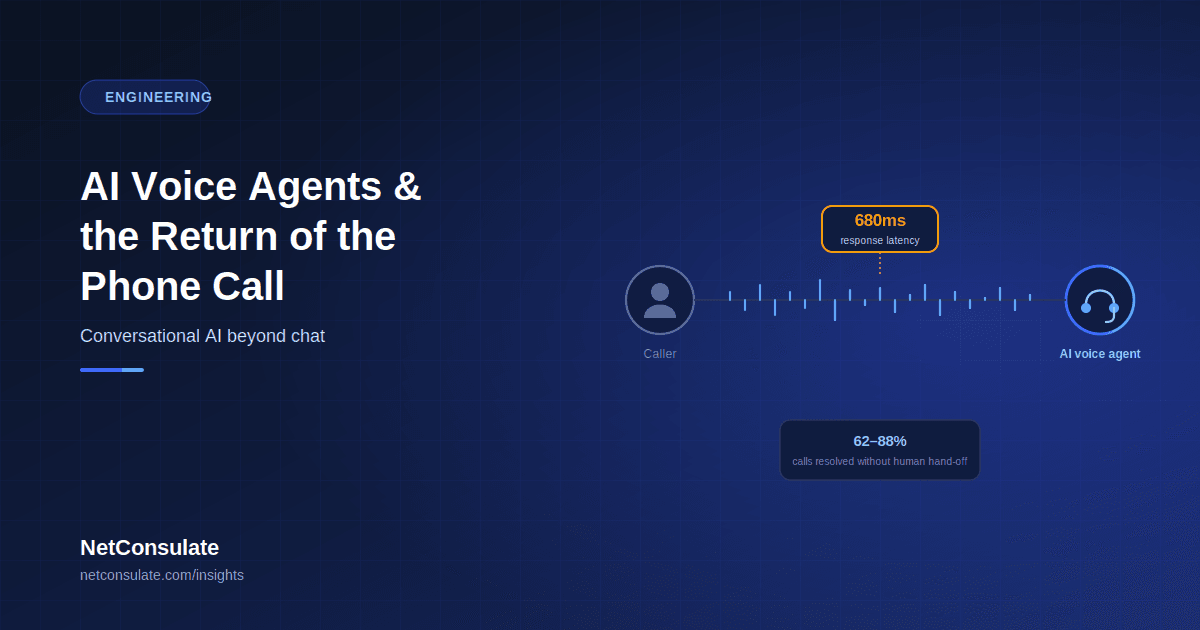
Independent benchmarking across a real fleet of 2026 production voice agent deployments found median end-to-end response latency of 680ms at p50 and 1,180ms at p95. The practical threshold that separates a voice agent that feels natural from one that feels broken is well understood among practitioners: anything consistently above roughly 1,200ms starts to produce the awkward pause where a caller says "hello? are you there?" and talks over the agent — the conversational equivalent of a dropped call, and often the moment a customer simply hangs up.
This is also where vendor marketing and real-world performance diverge most sharply. Available third-party tests often report meaningfully higher latency than vendor claims, and the size of the gap depends on what's actually being measured — a vendor figure should be treated as a product signal to verify under your own conditions, not a number to take at face value. One rigorous comparison tested six voice AI platforms under identical conditions — 100 concurrent calls over real PSTN circuits, mixed mobile and landline — specifically because latency issues often only surface at scale, not in a clean one-call demo. A system that sounds good in a sandbox and responds slowly under real concurrent load will fail exactly where it matters most.
What Voice Agents Actually Cost — and What They're Replacing
Real 2026 production benchmarks put all-in cost at roughly $0.07–$0.21 per connected minute depending on architecture and call volume, with individual platforms publishing transparent usage-based pricing around the lower end of that range. Against that cost, the substitution economics are stark: AI voice agents are reported to reduce operational costs by 40–60% compared to traditional call centre staffing, and Gartner forecasts conversational AI will cut $80 billion from contact centre labour costs by the end of 2026 — though explicitly only for platforms callers actually stay on the line for, tying the cost story directly back to the latency story above. A cheap voice agent that callers hang up on isn't a cost saving; it's a customer-experience liability with a monthly invoice attached.
The cost of the status quo is also worth stating plainly: businesses lose an average of $1.6 million annually from missed calls and slow follow-ups — a number voice agents address structurally, simply by being available continuously rather than during staffed hours.
Where Voice Agents Are Already Delivering Results
Inbound support and triage. Handling routine account queries, order status, and troubleshooting at any hour, with escalation to a human agent — carrying full conversational context, not a cold transfer — when a query exceeds the agent's defined scope. This escalation design is the same graduated-autonomy principle covered in our autonomous agents guide: routine cases resolved end-to-end, uncertain cases escalated with reasoning attached. Outbound sales and follow-up at volume. Structured outbound calling — lead qualification, appointment reminders, renewal follow-up — where consistency and volume matter more than the improvisational range a human rep brings. Businesses automating inbound and outbound calling report a 3x improvement in agent productivity and a 60% reduction in no-shows specifically, a direct result of consistent, scalable reminder calling that a human team could never sustain at the same volume. Appointment scheduling at call-centre scale. A high-volume, highly structured task — checking availability, confirming details, handling rescheduling — that maps cleanly onto a voice agent's strengths, with particular traction in home services, travel, and insurance verticals where scheduling volume is genuinely high. CRM and system-of-record updates during the call itself. The real value in enterprise deployment isn't the conversation — it's execution. Modern voice agents are expected to complete tasks, not just answer questions: updating a CRM record, booking a slot, triggering a workflow, all inside the call rather than as a manual follow-up step afterward. This is precisely where enterprises report the highest ROI, and it's the voice equivalent of the tool-calling architecture covered in our AppFunctions and autonomous agents guides — the agent isn't just talking, it's acting. Containment rate as the metric that actually matters for ROI. Well-scoped voice agent deployments in 2026 production fleets contained 62–88% of calls without human escalation — meaning the majority of routine call volume can be resolved entirely by the agent, with the remainder handed off cleanly rather than left stranded in a broken automated flow.What Building or Buying a Voice Agent Honestly Requires
Evaluate under real load, not a clean demo call. Nearly every credible enterprise buying guide converges on the same warning: vendors demonstrate near-perfect conversations in controlled environments, but real-world conditions — background noise, accents, interruptions, concurrent call volume — are far more complex, and latency problems specifically tend to surface only at scale. Any serious evaluation needs to test under realistic concurrent load on real telephony circuits, not a single polished sandbox call. Integration capability determines whether it's a tool or just an interface. One of the most overlooked but critical evaluation factors: many voice platforms focus heavily on conversation quality while lacking deep connection to the enterprise systems that actually matter — without integration, even a highly fluent voice agent becomes a limited interface rather than a business tool that can genuinely resolve a caller's need in one call. Compliance is non-negotiable in regulated industries, not a nice-to-have. For healthcare, insurance, and financial services deployments specifically, HIPAA and SOC2 coverage sit alongside latency and accuracy as baseline requirements, not differentiators — the same compliance discipline covered in our healthcare AI and AI governance guides, applied to a channel that now handles sensitive information in real time, spoken aloud, with no written record unless one is deliberately created. Infrastructure architecture materially affects latency, and it's worth understanding why. Platforms that co-locate telephony infrastructure with AI processing — keeping audio on a single private network rather than routing across multiple vendor handoffs — can break well below the 200ms round-trip barrier specifically by eliminating cross-network latency, a genuine architectural advantage over stitching together separate telephony, speech, and LLM providers. Deployment timelines vary enormously by approach, and that's a legitimate selection criterion. No-code platforms can have a production voice agent live in under three weeks without dedicated engineering resources; developer-led, API-first platforms offer far deeper configurability at the cost of requiring real engineering investment to stand up. Neither is universally correct — the right choice depends on how deeply the agent needs to integrate with systems unique to your business versus how quickly you need something live.A Readiness Checklist
- Target call types identified and split by complexity — routine, high-volume tasks are the strongest starting point, not the hardest edge cases
- Latency requirement understood as a hard constraint (sub-1,200ms p50 as the practical threshold), tested under real concurrent load, not vendor demo conditions
- Integration scope mapped against actual CRM, scheduling, and backend systems the agent needs to act on, not just talk about
- Compliance requirements (HIPAA, SOC2, call recording consent law) confirmed for your specific industry and jurisdiction before selecting a platform
- Escalation design specified explicitly — what triggers hand-off to a human, and whether full conversational context transfers with it
- Containment rate and cost-per-minute modelled against your actual call volume and current cost baseline, not industry averages alone
- Build-vs-buy decision made deliberately between no-code rapid deployment and API-first deep customisation, based on genuine integration depth needed
Conclusion
The phone call, written off by a decade of "digital-first" customer experience strategy, is returning as one of AI's most concretely valuable enterprise deployment channels — not because voice is nostalgic, but because a real-time spoken interface, done with sub-second latency and genuine system integration, resolves a caller's need in a single conversation the way chat and self-service portals often can't. The technology crossed from lab experiment to Fortune 500 production infrastructure within roughly two years, and the organisations getting real value from it are the ones treating latency, integration depth, and compliance as hard engineering requirements — not features to compare on a vendor spec sheet after the fact.
If your organisation is evaluating voice AI for customer support, sales, or scheduling, NetConsulate designs voice agent architecture end to end — from latency-optimised infrastructure and CRM integration to the compliance and escalation design regulated industries require.
Evaluating AI voice agents for your contact centre or customer operations? Submit a proposal request and our team will respond with a tailored approach within 2 business days.